FETCHING
THE MAILA
Rite of Passage in the life of
Steve Van Nattan, (Editor here) A
word about "tani boys." A
"tani boy" is a very special hired hand who rides your truck. He helps load it
and dig it out of the mud, and in the old days, he would crank the engine while
the Bwana would try to start it. Thus, his title, "tani boy," is a corruption
of what the Bwana yelled when he wanted it cranked-- "Turn, boy!" As progress
came, and as electric starters became standard equipment, the "tani boy" became
the guy who collected the tickets on busses and shoved the last poor victim through
the back door. To increase profits, the "tani boy" would stuff the coach of the
bus so full of passangers that he would end up hanging onto the back steps of
the bus, or he would climb up on top of the bus and lay on top of the baggage.
Well, the
day of my rite of passage had arrived. I was to take the empty mail bag from Kibara
to the Nansio post office and exchange it for a full one and bring it home, and
I would be on my own. Missionaries in those days got their mail in a big green
canvas bag, issued by the post office, and usually carried on a commercial bus
to the missionary's station. Kibara, our local town, was a dusty small town like
a thousand other dusty little towns in Africa. Business was carried on by several
concerns. There were the Indians from India in the biggest shops who offered every
conceivable gong and trinket an African could want. From the walls and ceiling
cascaded down an inventory that, in the USA or the UK, would fill a rather large
store, but in Kibara these shops looked very small from the street.
Africans also owned small
shops, like the bicycle shop and a tea shop. Luo tribal fishermen, who lived on
the papyrus shelf along the lake shore, would be hanging around the main street
trying to sell dried fish. The arrival of a bus was a pretty major event in Kibara.
Folks went to the doorways to see who would get on and off of the bus. Mail and
supply orders from far away would be dragged off of the top of the bus. The "tani
boy" might have a few chickens he wanted to sell to anyone willing to pay the
price. Negotiations were fast and doubtful. Then off the bus tore in a towering
cloud of dust headed for the next little town.
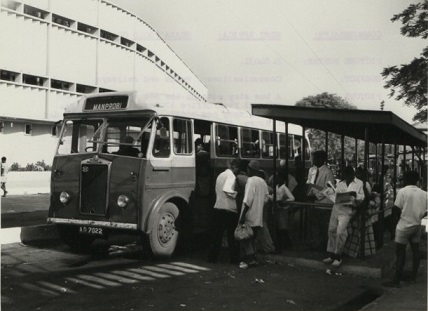
African busses in the 1950s
were not like anything you ever saw. A company in the capital city of Tanganyika,
Dar es Salaam, would order a chassis and drive train complete to be shipped
from the UK. Bedfords and Laylands were the companies of choice. Once the bus
chassis was in Africa, the local company who ordered it would then build a body
or coachworks on it. The body, in the 1950s would be built of wood, and it would
be bulky and heavy. Some companies did pretty good work, but after 50,000 miles
of washboard roads, the wooden framed coachworks would be real loose in the joints,
dear reader. Now,
the bus that pulled into Kibara that morning very early was well used. The back
was for general class travelers. It would seat perhaps 35 people on wooden benches
and maybe 20 more sitting on oil tins down the aisle and on one another's laps.
There were laws about overloading, but the rule of thumb was, "If your thumb could
fit inside, shove on in." My Dad made sure I got to ride First Class, which meant
I rode in the front seat with the driver. It cost two shillings more, but it was
worth it. There
was no cab as such for the driver. You see, the whole coachworks had to be supplied
after arrival in Africa. The wooden framework came all the way forward, and the
windshield was mounted in the wooden works. So, as we wound through the countryside
of Tanganyika at breakneck speed, I watched the whole coachworks shift at each
turn. There would be a distinct creaking groan from all sides as the bus lurched
to the right and then back to the left. In the upper right corner above my head
I could see right into the sky at times as the coachworks opened to add ventilation.
As
we progressed down the road, people would run out into the road to flag down the
bus. Each time the driver stopped, he would verbally rush the people faster and
faster until they could hardly get in the back door before he was under way again.
I could not understand why this mad rush. We finally reached some hill country
where there were long hills down to bridges and back up-- over and over. The bus
driver would press the accelerator flat to the floor going down hill until we
were careening along in terror, then BANG, hit the bridge deck with a crash, and
back up the far hill in an effort to stay in at least third gear.
I could not keep quiet any
longer. I casually asked the driver why the hurry. The driver told me that there
was another bus coming along behind us. Well, I wondered out loud what difference
that made. He told me he wanted to be the first bus to the Rugezi ferry crossing
from the mainland to Ukerewe island. You
see, we lived on a peninsula which terminated in an island named Ukerewe. Only
one road went to the island, and a ferry crossing was mandatory to get onto the
island and to the big town of Nansio where the Post Office and government offices
were. I thought about this for a while. 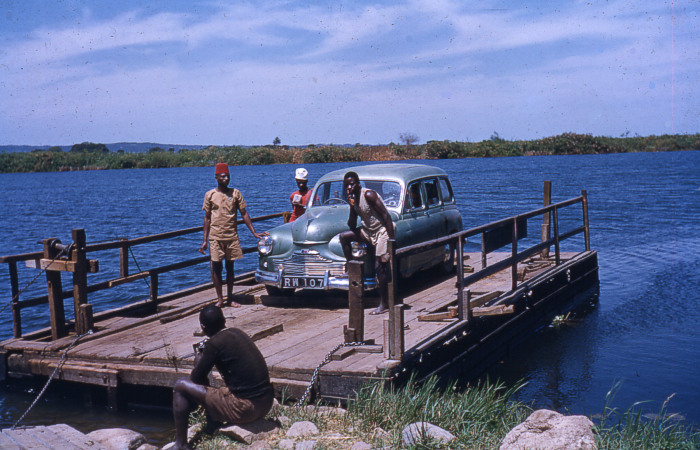 Thanks
to Mike Paterson from the UK, whose father served under the colonial office on
Ukerewe Island, for the photo of the Rugezi ferry at the left. Notice the chain
passing over the wheel which the workers used to drag the ferry along. Then
reality sunk in. When an ordinary automobile crossed over on the ferry, it
could be loaded, and all the passengers could stay aboard. But these ferries were
small pontoon arrangements. The hired helpers would drag the chain or cable up
from the lake floor over the ferry and drag the ferry along that way. Since
this was a lake, and there was no current as at a river crossing, the system worked
just fine. But, when a bus came along, the load was almost too much for the ferry
WITHOUT the passengers. So, the passengers ALL had to cross in dugout canoes.
This meant that a complex and lengthy process was followed since the whole top
of the bus would also have perhaps two tons of chickens, bags of corn, hoes, plows,
and just about anything your could imagine. Much of it might have to be offloaded
and, with the passangers, ferried across in the dugout canoes to avoid overloading
the ferry. The
second bus to the ferry crossing would have a very long wait while the first bus
was processed across. I forgot the terror of the moment and turned to the driver
and yelled, "Haraka, harake, rafiki." Roughly translated, that means in Swahili,
"Get going!" The driver lost all inhibitions. A representative of the White race
had just given him permission to put the pedal to the metal, and HE DID! He
still needed to stop and pick up more passengers though since the "tani boy" in
the back assured him he could cram in a few more. Hey, that's profit, right? Speed
and capitalism must be balanced in order to pay the bills. So, stops were perilous,
and everyone watched to the rear for the other bus. As we topped the hill
going down to the landing of the ferry, Layland Motor Works of England would have
been proud. The brakes worked splendidly. Coachworks of Africa, and chassis of
the UK, were still in reasonably good fellowship. Best of all, there was not one
car or bus at the ferry landing ahead of us. Cheers went up for the driver, and,
on my part, a prayer of thanks for deliverance went up to the Lord.
The process of crossing
the ferry was nerve wracking for the passengers. One of the luxuries of "going
First Class" was to ride the ferry across since there were only two of us in First
Class with the driver. So, I escaped crossing in a dugout canoe. The prospect
of this is not the canoe ride itself-- the terror is that they always overload
them due to the fact that another bus is coming soon. And sure enough, the second
bus rolled over the hill just as we were grinding onto the ferry in low gear.
Various groans could be heard from the second bus, "Bahati mbaya" (bad
luck) and "Min Allah" (Allah's will). In the rodeo of African transportation
though, our driver went up a couple of notches in fame.
The crossing was as uneventful
as it can be in Africa. One canoe had to be bailed constantly to keep it afloat,
but the passengers were always willing, what with the alternatives. On the other
side, we loaded up, and the ride to Nansio was leisurly since there was no more
pressure to arrive first. Nansio
is a combination of port, government center, commercial chaos, and gossip city.
The four principle Indian merchants in those days were Walji, Virji, Damji Mamji,
and JP Patel. Walji was the most friendly and the most crooked, but he had the
best inventory. JP Patel was the most honest and helpful but lacked the funds
to build a large inventory. Damji Mamji was probably a great guy, but we never
shopped there-- I don't know why. I
went around to Walji's and bought some candy or something to munch on. Walji insisted
on hearing how all of my family were doing, and he made me promise to take greetings
to my father. Walji was crooked in pricing and quite able to gouge if he could
get away with it, but he seemed genuinely sincere in his care of my parents. A
Hindu merchant is an obscure and perplexing person all of the time. If honesty
pays off best, he is as honest as anyone you ever knew. If lying and tricks turn
the best profit, count your fingers. Once the Hindu cleans up on you, he reverts
to sincere concern and friendliness, and he will demand that you stay for a cup
of tea. A Muslim merchant is just as friendly, but he is not a crook in business.
He does not have fifty more reincarnations after death in which to behave himself
and be good. There
was a soda pop bottling concern nearby, so I went over there for a cold soda.
That was a real luxury in Africa in the 1950s. There was no electricity in the
city during daylight hours, so the refrigerators, Servels from Sweden, were run
on kerosene. Several merchants kept cold soda in an aging Servel in the back room.
Whiskey was on hand for the Catholic priests. The flavors of soda pop were only
limited by the imagination of the merchant and had nothing to do with the flavor
of the beverage. My favorite was ice cream soda, which tasted more like rose water.
I
wanted to catch the first bus back home, so I went on to the Post Office to get
the mail. Switching bags was no trick, and off I went to the bus park. Now, in
all of Africa, except possibly where civilization has intruded in South Africa
and in big cities elsewhere in Africa, the bus leaves when it is full, and no
sooner. So, to get out of town quickly, I had to walk the line of busses and read
their destinations. The ones headed for far away destinations would leave first
since they had the prospect of picking up added passengers along the way to fill
the bus. I made my choice and was delighted to find it was about to leave. Again,
I managed to acquire a First Class ticket and a place in the front seat with the
driver. By
now it was very hot, perhaps 1 o'clock in the afternoon. Nansio had taken on the
mid-day odors of frying onions for the evening meal, mixed with various varieties
of manure around the town square, dried fish, and elderly cuts of beef hanging
in the meat market in the center of town. The dogs were in slow motion, as were
many of the inhabitants. The driver was in a subdued mood due to the mid-day heat,
but he was happy to see the bus full. Mamma would have enough cash to buy more
beans and casava for the babies when he got home tomorrow. With some luck they
could buy a goat for the coming celebration of their son's return from the government
school in Mwanza. Life was good, and I was heading home. Speed would not be so
high a priority since the next bus was not nearly full and would not be trying
to pass us on the way back to the ferry. The
driver's section of the bus was comfortable enough, but the back of the bus was
an oven. It would have been better if the poor passengers had not been crammed
in like sardines. In any case, we made the ferry and crossed without a hitch,
and we were on the mainland cruising along fine when someone in the back lost
their lunch. The bumps on the road, along with the sweltering heat, had taken
their toll. The groans were audible as people got sick one by one by proxy. Each
sick passenger inspired one behind him, and on those bus lines there were no little
brown bags provided, like on your favorite airline.
Well, it was getting tense
and depressing. What was needed was a distraction. In Africa, in Tanganyika,
circa 1956, on any given day along the roads and pathways, distractions are pretty
easy to come by. Thus, a dear old man riding a bicycle was our distraction.
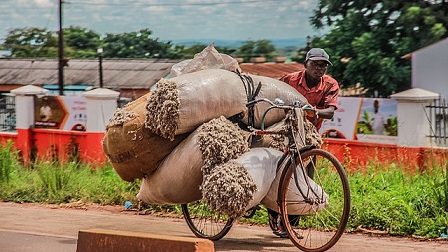 In
all of Africa, there is a special kind of bicycle sold in nearly every Indian
shop. It is made in England or Hong Kong, and it is more like a truck than a bicycle.
I believe China still makes these vehicles by the hundreds of millions and
ships them around the world. Three Pigeons was the most famous brand in East Africa.
This bicycle can be loaded until you would be in awe and expect it to break in
half. A whole family can climb aboard. A special carrier is attached on the rear
which is massive and holds a great load. The bicycle is then peddled slowly
since it is so heavy. It can be loaded even heavier, but the owner must walk it
down the road since it would fall over if he tried to ride it. In
all of Africa, there is a special kind of bicycle sold in nearly every Indian
shop. It is made in England or Hong Kong, and it is more like a truck than a bicycle.
I believe China still makes these vehicles by the hundreds of millions and
ships them around the world. Three Pigeons was the most famous brand in East Africa.
This bicycle can be loaded until you would be in awe and expect it to break in
half. A whole family can climb aboard. A special carrier is attached on the rear
which is massive and holds a great load. The bicycle is then peddled slowly
since it is so heavy. It can be loaded even heavier, but the owner must walk it
down the road since it would fall over if he tried to ride it.
As we cruised along in the
bus, we came to an area where the road made slow graceful curves back and forth
as huge clumps of wait-a-bit thorn bushes were negotiated. Roads in Africa don't
go through such obstacles-- they simply go around them. The "right of way"
is whichever way provides the least resistance. Each of these "bushes"
was really huge, averaging maybe fifteen feet high and forty feet across.
As
we rumbled along this way in the heat, we came around a particularly large bush
of wait-a-bit thorns-- perhaps 100 feet in diameter. Half way around the curve,
we met an old gentleman on a bicycle coming the other way, fully loaded with some
unknown cargo, and just creeping along. The bus driver blasted the horn, and I
thought we would run right over the old man. Well, the fellow did the only
thing he could do-- he turned and parked the bike in the thorn bush. The bus zipped
past his rear wheel missing it by inches. The wait-a-bit thorn bush was so thick
that after he crunched into the bush, and after we tore on down the road, he was
left there perfectly upright, sitting motionless on his bicycle, and totally
supported by the thorn bush. The wait-a-bit thorns were supporting him as they
clung to his clothing. Now,
African wait-a-bit thorns are like millions of fish hooks and grow on canes similar
to roses. If you even brush up against them, you are caught solidly. To pull away
would mean the end of your clothes and probably some nasty cuts. They can
be escaped from only by stopping and peeling the branches off slowly, thorn by
thorn. Now, imagine yourself on a bicycle, completely encased in, and propped
up by, a million wait-a-bit thorns and no way to back out.
Well, Africans don't deal
with disaster like Westerners. The whole bus load of passengers saw every detail
of the scene and action as we tore by, and they all broke up in hilarious laughter.
Africans laugh at disaster, even if they are the one suffering. I don't know
about the old man. It just might have been too much for him to be merry at
that point. But, the driver broke into such fits of laughter that he nearly drove
into a tree. The
roaring of laughter went on for miles, but finally it settled down. After a period
of quiet, an old gentleman in the back began to tell a story. "Once upon
a time there was an old man named Tembo. He needed to get some corn to market
to sell to feed his chickens, and he wanted to buy some things for his family.
So he set off early one morning from his village and on his bicycle to go to the
market in Nansio." On and on the story went. Finally I realized that this fellow
was telling the story of the old man on the bicycle in the thorn bush. When the
story teller finally got to the part where the old man met the bus, all of the
passengers were on pins and needles. As the story teller described the crunch
of the bicycle into the thorn bush, the whole bus broke up all over again roaring
in laughter, including the driver. This
went on all the way home to Kibara. Over and over the story teller would
tell the story, every time the same plot, with some amendments to create more
suspense, and the passengers loved it. It also helped all of us forget the heat
and stench of lost lunches. I
suppose life is very different in Kibara today. The busses are much nicer. They
build them with steel coachworks now, and there are nicer seats and better ventilation.
There are now even laws limiting the number ot passangers. It just is not like
it was long ago. But, somewhere on the Kibara plains, late at night around a low
fire, I dare say you can still hear a story about the old man on the bicycle and
the wait-a-bit thorns..... "Once upon a time there was a farmer named
Tembo. He had a bag of corn he wanted to sell in Nansio. So, he loaded the corn
on his bicycle, and he set off for the market....." Some
things are just too good to leave behind.

BACK
TO YARNS MENU BACK
TO ENTRY PAGE OF THE JOURNAL |
